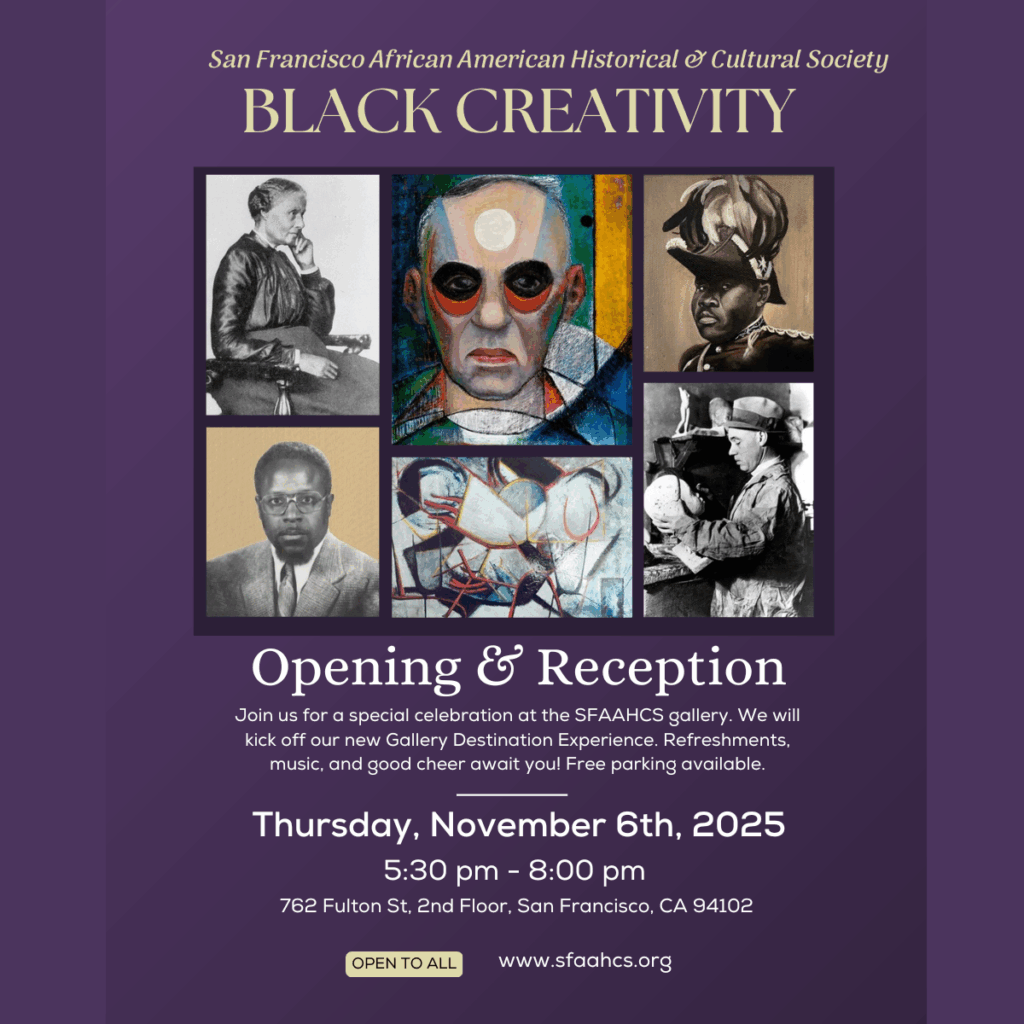
Current Exhibitions
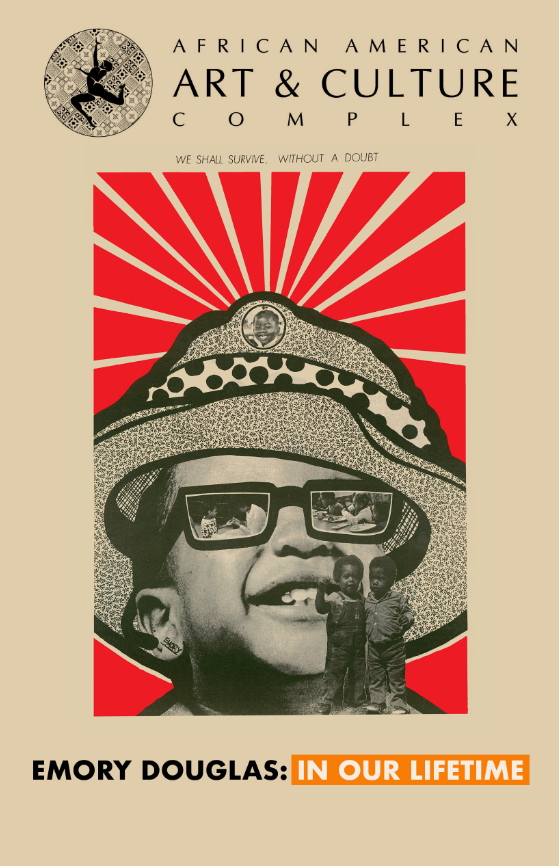
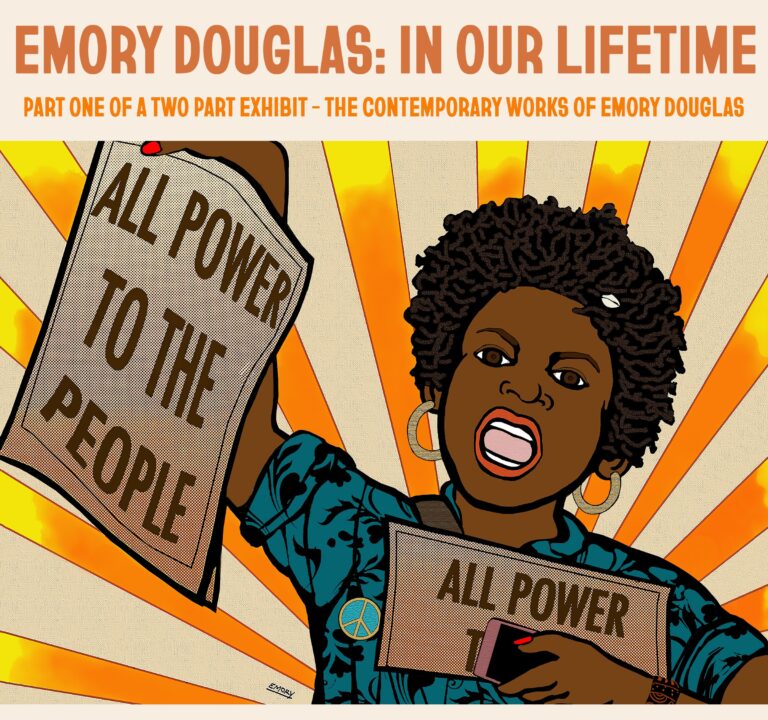
Emory Douglas: In Our Lifetime
Emory Douglas: In Our Lifetime is a survey of the work and vision of the revolutionary artist spanning over 50 years.
Group Tours available Tuesday-Friday. Click here for more information.
Join us every 3rd Thursday of the month for exhibition-related programming.
PLEASE NOTE: The Emory Douglas: In Our Lifetime exhibition contains historic and contemporary depictions of violence against the Police, armed revolution, detention of children by ICE, the Palestinian genocide, and violence in Haiti.Location:
FIRST FLOOR
Sargent Johnson Gallery
The digital era of Emory Douglas
SECOND FLOOR
Lobby
Mural enlargement by Darryl Thompson
Hall Gallery
The Revolution in Print
Cartooning for the Revolution
Portraits and Iconography – The Faces of Resistance
THIRD FLOOR
Lobby
Media Projection Wall & more
Hall of Culture
Haiti, Palestine, and Modern Solidarity Movements
Collaborations and Remixes
Children, Parenthood, and the Future of the Revolution
Exhibition Run: Dec 5, 2025 – October 2026
Join us every 3rd Thursday of the month for exhibition-related programming
About Emory Douglas
Born in Grand Rapids, Michigan, and raised in San Francisco, Douglas’s path to graphic agitation began unexpectedly. At age 13, while at the Youth Training School in Ontario, California, he was assigned to the laundry’s print shop, where he mastered the basics of commercial printing. He later refined these skills at the City College of San Francisco. In 1966, an invitation to design a poster for an event honoring Betty Shabazz led to a meeting with the founders of the Black Panther Party. Douglas offered his technical expertise to improve their nascent newspaper; he was soon named the “Revolutionary Artist” of the movement—Minister of Culture.
Douglas’s signature style—characterized by bold linework, two-color printing, and resourceful textures—transformed The Black Panther community newspaper into a weapon of the revolution. Often dubbed by Bobby Seale as the “Norman Rockwell of the ghetto,” Douglas rejected the patronizing lens of traditional social realism. Instead, he portrayed the poor and oppressed with profound dignity, illustrating both the harsh realities of systemic inequity and a “visual mythology” of reclaimed power. He was also responsible for stylizing the iconic Black Panther logo—a symbol originally adopted from the Lowndes County Freedom Organization—which became a global beacon of resistance.
Throughout his tenure and in the decades since, Douglas has connected the Black American struggle with international liberation movements. His career is a testament to the Black Panther Party directive “each one teach one”; he not only designed the paper but trained fellow members in the art of graphic production. Following the Party’s transition, he continued his work as a pre-press artist for the San Francisco Sun-Reporter and remains a vital political voice today.
In recent years, Douglas has embraced digital media to comment on modern injustices, collaborating with movements such as the Zapatistas in Mexico and Black Lives Matter. His honors reflect a lifetime of global influence:
- 2007: Major retrospective at MOCA Los Angeles.
- 2015: Recipient of the AIGA Medal for his work as a “social catalyst.”
- 2022: Inducted into the Society of Illustrators Hall of Fame.
- Permanent Collections: His work is held by the MoMA, the Tate, and The Metropolitan Museum of Art.
Emory Douglas continues to create art that protests the present while envisioning a future of harmony and peace. His manifesto for visual activists ensures that the message—“All Power to the People”—reverberates through new generations of organizers, proving that the struggle for liberation is a commitment held, and won, in our lifetime.
The Battle Cry "CULTURE IS A WEAPON"
The battle cry “Culture is A Weapon” is a powerful tool in all of its expressions and forms it has the power to transform the Colonization Of The Imagination.
It is a reflection of our history of resistance and a product of that history.
Like the flower is a product of the seed.
“Culture Is A Weapon” at this time in history is the manifestation of the extreme reactionary times in the world we are living in today.
As a definition it is no absolute but a continuation of expressions and Interpretations, compassion, love, beauty, pain and suffering that one feels and observes that penetrate the souls of the resistance via the resistors (We The People) against all forms of cruel and unjust authority.
“Culture Is A Weapon” as a concept it is the creative vehicle to communicate genuine truths about social concerns truths you will never hear expressed by any reactionary or bureaucrat.
It is our duty as the makers of The Arts Of Resistance to always recognize the oppression of others.
The goal should be to make the message clear so that even a child can understand it.
Don’t be fooled by deception.
Know the rules before you break them.
Don’t lose sight of what the goal is.
ALL POWER TO THE PEOPLE!
In Media
KRON4 – Live! in the Bay – Art, identity, and activism at the African American Art & Culture Complex
KPIX/CBS News Bay Area – Emory Douglas exhibit on Black Panther Party opens in San Francisco
KPIX/CBS News Bay Area – Black History Month – A CBS News Bay Area special
Black Creativity
The San Francisco African American Historical and Cultural Society exhibit’s highlights the careers of four outstanding individuals and their unique contributions to their communities and the world they lived in. The first, the Sargent Claude Johnson exhibit, is the story of a determined Black multi-talented artist, despite all odds, becoming an outstanding, celebrated mid-twentieth-century artist in the Bay Area.
The Second, Montford Cardwell, an incredible Renaissance artist who lived in San Francisco during the 60s-70s and who has not been recognized for his contributions to the art world.
The third, Ms. Mary Ellen Pleasant, a civic leader, philanthropist and civil rights advocate who risked her life and wealth for what she believed. And the fourth, Carlos Martinez, whose incredible creation, “The American Experience 1900-1950,” speaks for itself. African art sculptures, which have been a source of inspiration for Sargent Claude Johnson and many minority and non-minority artists, are present and generate their own energy.
Location: 2nd Floor The San Francisco African American Historical and Cultural Society
Hours of Operation: 12-4pm, Tuesday-Saturday
Exhibition Run: November 6, 2025 – March 31, 2026